Indian Genealogy Along Wiht Greene Family of Rhoide Island
History of the Colonization of America and the original 13 Colonies
Colonial Rhode Island: The Establishment and Settlement of the thirteen original colonies
The History of Colonial Rhode Island
Rhode Island was first discovered in 1524 by the Italian explorer Giovanni da Verrazano (1485 - 1528), who was interim on behalf of the French. He was followed past the British explorer Henry Hudson (1565-1611) who explored the area on behalf of the Dutch. The state was originally given the Native Indian name of Aquidneck which is derived from the Narragansett give-and-take literally meaning the "Isle of Peace." Ane of the Dutch explorers, Adrian Cake (c.1567 � 1627), named the expanse "Roodt Eylandt" pregnant "red isle" referring to the red clay that lined the shore. The region was controlled past the Wampanoag tribe, whose leader was Chief Massasoit, the father of Metacomet who would become known every bit King Philip of Pokanoket. In 1635 the colonist Roger Williams was banished from Massachusetts for his religious teachings and in 1636 he settled in the area of Colonial Rhode Island naming the area Providence Plantations. Chief Massasoit eventually gifted Roger Williams with Aquidneck Island, Providence and Prudence Island for his friendship. English colonists from Massachusetts including Anne Hutchinson, William Hutchinson, William Dyer, John Coggeshall, William Coddington, Nicholas Easton, William Brenton, John Clarke, and Richard Maxson first settled in Aquidneck in 1638. They were led by Anne Hutchinson who had been found guilty of heresy and condemned to banishment by the Ceremonious Courtroom. In 1644, the colonies of Rhode Island and Providence Plantations combined to form Colonial Rhode Island which would eventually go the Land, of "Rhode Island and Providence Plantations". On July 15, 1663 King Charles II granted the Charter of Rhode Island and Providence Plantations.

Movie of Anne Hutchinson
Native American Indians and Conflicts in Colonial Rhode Isle
The Native American Indians of Rhode Island included the Nipmuc, Pequot, Wampanoag and Narraganset. The settlers in Colonial Rhode Island were involved in the following conflicts:
- The Pequot War of 1637
- King Philip's War (1675 - 1677 ) named later Metacomet of the Wampanoag tribe. During Rex Philip's War, up to one 3rd of America'due south white population was wiped out
- The French and Indian Wars (1688 - 1763) consisting of King William's War (1688-1699), Queen Anne's War (1702-1713), Rex George's War (1744 - 1748)
- The French Indian War (1756 - 1763)
- The American Revolutionary State of war (1775 - 1783). The Usa of America is created and Colonial Rhode Island becomes a country
Religion in Colonial Rhode Isle
The Puritans dominated New England and were a Reform movement in the Anglican church building that aimed at purifying the church of corruption. The religion of the Puritans who had settled in Massachusetts was strict and austere leading to dissent with many church members. The state of affairs was so serious that Anne Hutchinson was found guilty of heresy and condemned to banishment by the Civil Court which led to the establishment of Colonial Rhode Isle. The group of Nonconformists and Dissenters believed in religious freedom, and the separation of church building and state whereas the Puritans in Massachusetts believed in a government and order tied to the church. The Rhode Island Charter of 1663 proclaimed that a "flourishing ceremonious state may stand and best be maintained with total liberty in religious concernments." Other colonists including Catholics and Jews settled in Rhode Island which immune them religious liberty.
Regime in Colonial Rhode Island
Anne Hutchinson and her followers established a home in Portsmouth and adopted a new government which provided for trial by jury and separation of church and state. In 1651 England claimed the right to appoint a governor for Rhode Island and Providence Plantations, with a provincial council, to be elected by the freeholders and accepted past the Rex. On July 15, 1663 King Charles II granted the Lease of Rhode Island and Providence Plantations. Colonial Rhode Island became a Lease Colony which was largely self-governed. The charter established the rules of authorities, merely immune the Rhode Island colonists a peachy corporeality of liberty within those rules. The system of Government in Colonial Rhode Island was structured equally follows:
- The Governor of Colonial Rhode Isle held the executive ability in the colony representing the Crown (England)
- The Governor�s Quango of Colonial Rhode Isle was composed of influential and powerful men who brash and supported the Governor and had judicial and administrative powers
- An Assembly was elected by and represented, the citizens of the towns and counties of Colonial Rhode Island
- Town Meetings
1663 Charter of Rhode Island and Providence Plantations
Natural Materials and Raw Resources in Colonial Rhode Isle
The Natural materials and raw resources available to the colonists in Colonial Rhode Island were fish, whales and timber from the dumbo forests. Farming was difficult for crops similar wheat because of the poor soil simply corn, pumpkins, rye, squash and beans were raised.
Life in Colonial Rhode Island - Economic system, Trade, Industries and Jobs
The way of life in Colonial Rhode Island was adamant by organized religion, wealth, status and how colonists could make a living. The majority of the workforce in Colonial Rhode Island consisted of transmission workers, servants, apprentices, sailors, hired hands and semi-skilled tradesmen. These were colonists of the lower class could non vote nor hold public office. few owned belongings and most were illiterate. The lower classes were bolstered by Indentured Servants and some slaves. The Middle class citizens of Colonial Rhode Island could vote but few held public office. They ran stores or pocket-size businesses, were skilled tradesmen or belonged to professions. The Upper class consisted of wealthy and well educated minor aristocrats who could vote and held loftier public office. The economic system of Colonial Rhode Island was based on manufacture and industries such every bit send building and the manufacture and consign of rum. The mode of life focussed on town life. The way of life focussed on town life. The names of the major towns in Colonial Rhode Island were Providence, Portsmouth and Newport. In towns along the coast, the colonists made their living fishing, whaling, shipbuilding and shipping. The economy of other parts of Colonial Rhode Island was based on timber products, the fur trade, maple syrup, copper, livestock products, horses, rum, whiskey and beer.
Facts about the Rhode Isle Colony
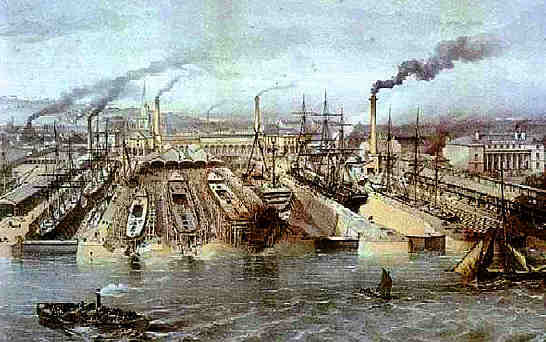
New England Send Yard
Colonial Rhode Island - The Colony becomes a State
When, how and why did Colonial Rhode Isle become a State? On April 18, 1775 the American War of Independence began. The 13 original colonies, including Colonial Rhode Isle, had not separated from United kingdom of great britain and northern ireland at the first of the war and there was no American government. Colonial Rhode Island had a system of government in which they elected their governors under self-governing rule. The xiii Colonies asked the Continental Congress to straight the war and Congress, unexpectedly, became the governing trunk of North America. On May 15, 1776 Congress advised Colonial Rhode Island and all the other colonies to form governments for themselves and write their ain constitutions. Colonial Rhode Island was used to self-government and kept its existing lease as their constitution. Rhode Island was the 13th of the original 13 colonies to become a state on May 29, 1790. For boosted facts and info refer to the Modify from Colonies to States.

Rhode Isle State Flag
Colonial Rhode Island
This Colonial Rhode Island article provides important information and interesting facts about the Colonial Rhode Island including the history, the engagement the colony were established, geography, jobs, the organisation of government, faith, merchandise and the economic system of the Rhode Island Colony. An easy, helpful educational resource for teachers, kids and children about Colonial Rhode Island.
Colonial Rhode Island
- Interesting Facts and information virtually Colonial Rhode Island
- Colonial Rhode Isle life, history and people
- Fast Facts and info about the religion, authorities, jobs and the economy of Colonial Rhode Island
- Social Studies Homework help for kids and schools about Colonial Rhode Island
Source: https://www.landofthebrave.info/colonial-rhode-island.htm

Postar um comentário for "Indian Genealogy Along Wiht Greene Family of Rhoide Island"